


















Updated: Sep 1
New market research singles out trends in dining occasions — literally. One notable takeaway from Circana’s latest Eating Patterns in America report is the rise of solo meals, both at home and away from home.
The recently released study showed that consumers are eating alone across locations and dayparts. "The past few years witnessed a return to social occasions post pandemic, but this year saw a rise in solo occasions, driven by increased workplace mobility and a need for simplicity," said David Portalatin, SVP and Industry Advisor, Food and Foodservice, at Circana. "In addition, older and more affluent consumers in smaller household sizes are better able to afford an away from home occasion."

Home Alone
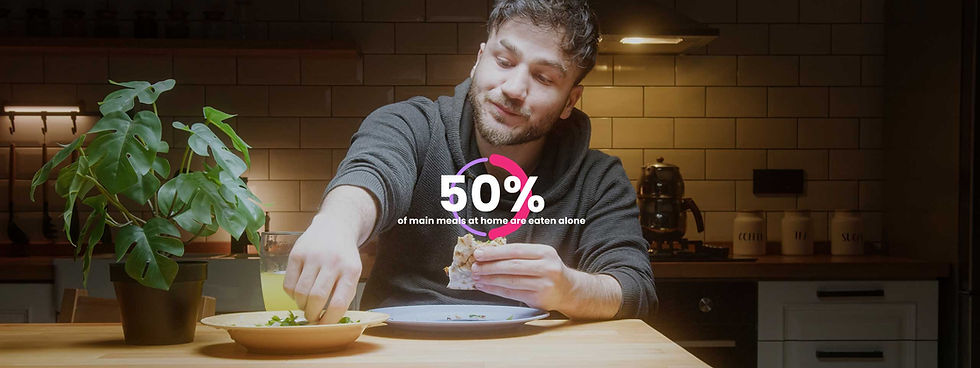
Insights indicate that more people are pulling up a chair for solo meals where they live. An even half (50%) of main meals at home are eaten alone, per Circana’s National Eating Trends® data. That’s up two points from a year ago and four points higher than 2021.
In comparison, 49.7% of at-home meal occasions happen with others or are part of a social occasion. That figure was 52% in 2025 and 50.5% in 2024.
People are eating alone throughout the day, underscoring the broader shift. Circana insights reveal that 59% of consumers enjoy a solitary breakfast within their own four walls, up 3.1 points from last year. Meanwhile, the number of consumers who reported that they eat morning meals with family members at home declined 2.1 points from 2025.
Most lunches and snacks are likewise eaten on an individual basis at home. Nearly six in 10 home lunches are eaten alone, while 65% of snacks are solo. For many people eating at home, time is of the essence: almost two-thirds of in-home breakfasts and more than half of in-home lunches take less than five minutes to prepare or cook.
Putting “Me” in Menu
The latest Eating Patterns in America report supports the increase in solo dining at foodservice, too. Parties of one grew at commercial foodservice in the past year, while parties of two or more people decreased, Circana’s CREST® research shows.
As with at-home dining, single orders in restaurants span occasions and locales. The shrinking of party size is most prominent at full-service restaurants: individual visits comprised nearly a quarter (23%) of full-service visits during the first quarter of 2026.
On a daypart basis, solo parties are most common for morning meals. Parties of one have a 59% share of foodservice breakfast occasions, followed by parties of two at 18%.
Many customers snack on their own away from home, too. Solo snacking drives the majority of foodservice visits, with a 50% share of traffic. Parties of two comprise 17% of traffic for snacking occasions, and parties of three represent a third.
Portalatin underscored takeaways for those who serve such consumers. "Retailers and foodservice operators can leverage flexibility in packaging, portability and portion sizes to help meet the needs of solo diners on the go, balancing their preferences with consumers in larger households," he advised.
Now in its 41st year, the Eating Patterns in America report highlights other key eating and drinking trends, from the pursuit of protein to the ongoing quest for convenience. The report is based on analyses of billions of occasions.