
























Distribution voids are one of the hardest availability issues to detect. The systems built to flag them often report everything is fine, but in reality, that’s not the case.
In this situation, voids are missed because stock files show inventory, replenishment systems stay quiet, and head office teams don’t look at the individual store-item level. Since nothing looks unusual in the data and systems, lost sales can persist for months. Brands underperform without explanation, shoppers leave frustrated, and retailers may make assortment decisions based on incomplete information. To avoid those problems, it’s important to have a shared view between retailers and manufacturers that includes store/item/day data and automated alerting.

What Is a Distribution Void?
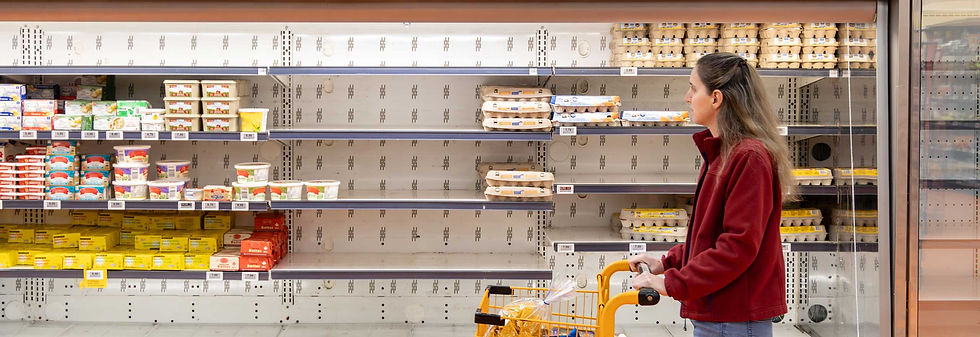
Simply put, a distribution void is a product that is not where it is supposed to be, has not been for some time, and is not selling. Even though the retailer and manufacturer agreed that the item should be on the shelf, a step was missed or a conflicting action was taken somewhere between that decision and execution.
In practice, the term also covers a broader set of cases. When an item has been out of stock for an extended period, analytics tools typically classify it as a distribution void, regardless of the original trigger. A prolonged absence functions the same way at the shelf, and it demands the same level of investigation.
Distribution voids differ from a shelf out-of-stock (OOS) in two critical ways: duration and cause.
Shelf Out-of-Stock | Distribution Void | |
Duration | Short term | Long term |
Nature | Sold through, not yet replenished | Never shipped, dropped from replenishment, or accidentally removed. |
Root cause | Demand spike vs. replenishment lag | Item setup error, planogram omission, replenishment lapse |
Scope | Operational | Systemic |
From a duration standpoint, a distribution void is a longer-term situation than a shelf OOS. Accordingly, it indicates a larger, systemic problem.
Causes of distribution voids also make this a distinct issue. Typically, such voids can be attributed to process and setup failures. In a distributed replenishment environment like a retail store chain, however, there are thousands of individual touchpoints where decisions can be made that conflict with the overarching intent of the retailer or CPG. These individual decisions can create distribution voids that are hard to find when looking at aggregate data.
How Distribution Voids Begin
Distribution voids rarely start with a dramatic failure. Instead, they can be traced to a seemingly minor break in a routine process.
The planogram omission
A product is intended for the shelf but is accidentally left off the planogram. Without a planogram position, the item has no home in the store, and no system expects it to be there.
The launch that never repeats
New items are often pushed to stores at launch, with inventory forced to every planogrammed location. The product may appear on the shelf for a short time, but if the item was never properly set up for ongoing replenishment, the system never pulls it again. The launch looks successful on paper, then the product quietly disappears.
The replenishment lapse
An item can be taken off replenishment for a range of reasons, sometimes intentionally and sometimes not. Once that happens, the replenishment system stops ordering, and nothing in the standard workflow signals the problem.
The shelf label problem
Removing the shelf label is one of the most damaging causes of a distribution void. A store associate notices an empty space with a tag but no product. Instead of investigating or placing a manual order, the associate removes the tag to tidy the shelf.
Once the label is gone, though, the store stops looking for the product. Associates no longer see a reason to order it. The item may still exist in the system, but the store does not believe it should carry it.
In each of these cases, the product is absent due to a broken process, not because shoppers bought all of it. That distinction matters, since the fix is different. Ordering more will not solve a problem that sits in item setup or authorization.
Why Distribution Voids Go Undetected
Whatever the cause, distribution voids can persist under the radar for a surprisingly long time. The reasons for that lengthy period of invisibility may vary, but essentially, the systems designed to catch availability problems often report that no problem exists. As a result, the system does not replenish, and alerts don’t fire.
Head office lacks store-item visibility
Central teams typically review performance at the chain, banner, or regional level. At that level, a void in a handful of stores looks like modestly lower velocity, not a missing product. That means a distribution void can look like low velocity when viewed at the banner level.
Store teams manage thousands of SKUs
Store operations teams cannot manually check every item in every aisle on every visit. Shoppers move products, displays shift, and gaps blend into the shelf. When tags disappear, neighboring items spread out to cover the hole. Without a prompt, a missing item is easy to overlook.
Systemic breaks don't trigger expectations
If a void happens due to a systemic break, nobody will see it because it wasn’t expected in the first place. If a store removes an item from its own system, the store will not look for it. And the office will not see it either, since it is not reviewing that individual store-item combination.
The Business Cost of an Invisible Gap
Distribution voids carry costs that extend well beyond a single missed sale.
Lost sales accumulate over time. Because voids are long term, every week of absence compounds the loss.
Brands underperform without explanation. A brand can languish at a retailer while its manufacturer has no clear view of why.
Shoppers experience friction. A product that is never available pushes shoppers toward another store or a competing brand.
Assortment decisions rest on flawed data. When a retailer evaluates whether to keep or cut an item, a distribution void makes the product look weaker than it is. The decision is made based on an unidentified availability failure, not shopper demand, and sales are not maximized.
How to Spot and Resolve Distribution Voids
Detecting a distribution void requires something no single system provides on its own: a comparison between what should be in a store and what is actually selling there. Here are some ways to identify this issue:
1. Match both sides of the data
It’s crucial to reconcile authorization, planogram, and inventory records against store-level sales behavior. When a product should be present but shows no sales, or sells sporadically without consistent replenishment, the mismatch points to a void.
2. Evaluate at the store/item/day level
Aggregated data hides voids. Store/item/day data reveals when sales stopped, where the gap sits, and how a store compares with similar stores carrying the same item. That level of detail separates a true void from just a slow mover.
3. Use AI-powered alerts to flag gaps early
Manual store walks cannot scale across thousands of SKUs and stores, but automated alerting can. These alerts can sift through all the relevant data and flag that a product should be in this store and currently is not.
4. Direct field sales to the right stores
Alerts are most valuable when they drive targeted action. Rather than relying on a broker visiting a few stores on a set schedule and reporting anecdotally, manufacturers can send field sales teams to the specific locations where voids are confirmed. Field teams arrive knowing what to look for and why it matters. It is no longer a random search; it is now a targeted mission that maximizes the value of every minute spent in store.
5. Assign the fix to the right owner
A distribution void caused by an item setup error requires a correction in the retailer's system. A void caused by a missing planogram position requires a space decision. A replenishment lapse requires reactivation. Diagnosis determines ownership, and ownership determines speed to resolution. Knowing who can fix each issue results in true corrections not just temporary fixes.
Why Collaboration Closes the Gap
Distribution voids are a clear example of a supply chain visibility gap. Manufacturers can’t see the shelf, while retailers often are not resourced to see store-item details at scale. Each side holds part of the picture.
Shared data changes that dynamic and creates a full picture. With Circana's Liquid Supply Chain™ solution, retailer data is harmonized into a single view across the CPG enterprise while retaining individual retailer views. A cross-retailer perspective also helps manufacturers determine whether a gap is isolated to one account, pointing to a local setup or authorization issue, or present across retailers, pointing to an upstream challenge.
When both parties work from the same facts, conversations shift from assumption to evidence and distribution voids can be closed for the benefit of all.
Explore Circana's supply chain solutions to address and solve problems like distribution voids.
Frequently Asked Questions
What is a distribution void?
A distribution void is a long-term absence of a product from a store where it is intended to be sold. It typically results from an item setup error, planogram omission, or replenishment lapse.
How is a distribution void different from a shelf out-of-stock?
A shelf out-of-stock is short term and occurs when product sells through faster than it is replenished. A distribution void is long term and systemic, caused by a process failure rather than demand.
Why do distribution voids go undetected?
Inventory records often show stock, replenishment systems do not trigger, and head-office reporting is too aggregated to reveal store-item gaps. When an item disappears from ordering systems altogether, whether removed on purpose or by mistake, nothing flags it as a problem unless someone knows it was supposed to be available.
How can retailers and manufacturers detect distribution voids?
By matching authorization and inventory records against store/item/day sales data, using AI-powered alerts, and directing field sales teams to confirmed gaps.
Find the Voids Before They Cost You More
Distribution voids are not inevitable. They are detectable, diagnosable, and fixable when retailers and manufacturers have the right data at the right level of detail.
Explore Circana's supply chain solutions to surface distribution voids early, direct your teams to the right stores, and recover the sales your systems have been missing.
Thomas Elliot is Senior Director, Business Development, Supply Chain, at Circana, and Nicola Webb is Director, Supply Chain, at Circana.